Operators Brief
The Weekly Drop
Operators Brief #003 — How to read a room when nobody's telling you the truth
Issue #003 · May 3, 2026
Real Intel. Real Impact. Mission Always.
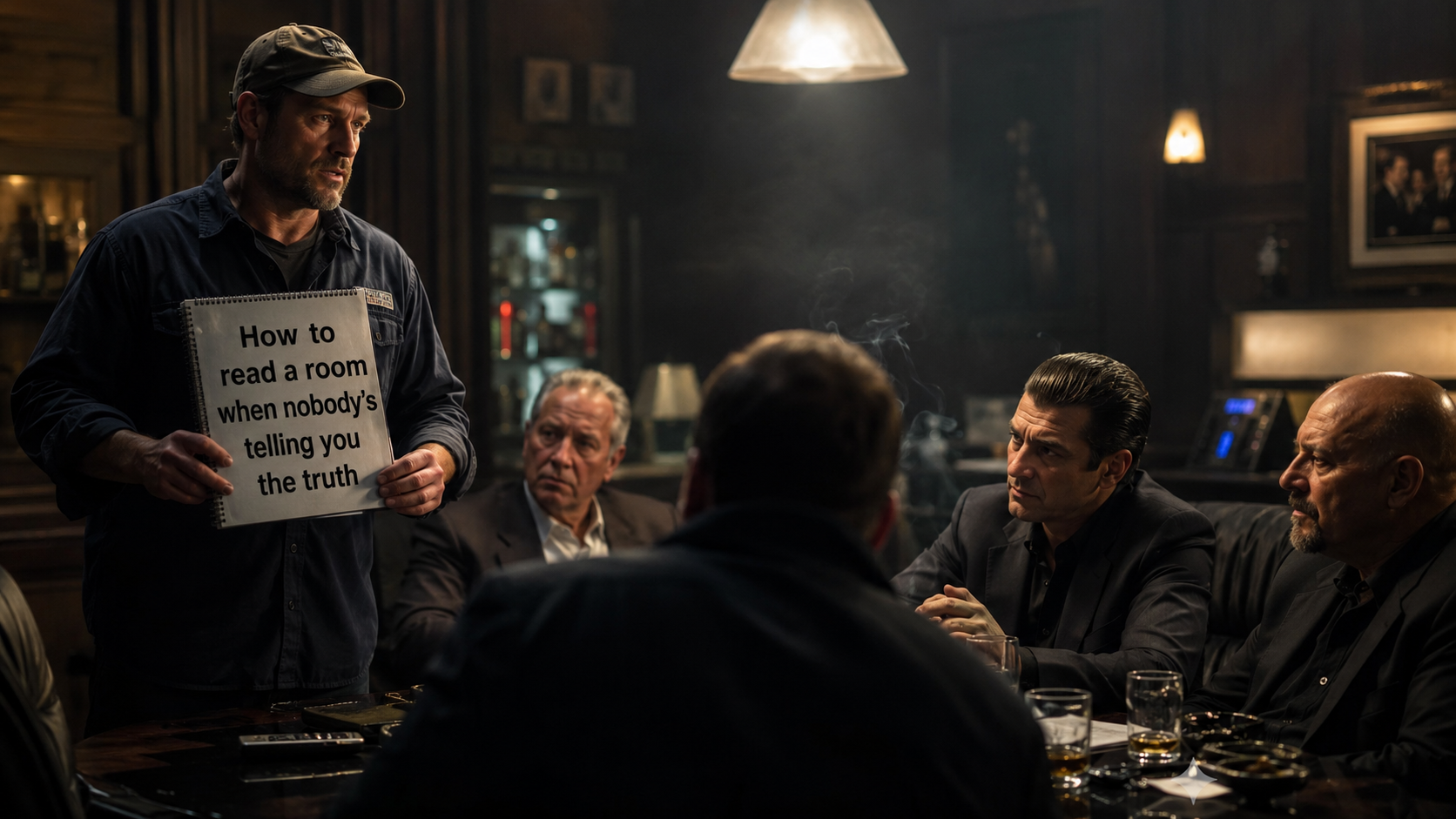
Why the most useful question you can ask isn't a question.
Operators Brief — Issue #003
_May 03, 2026 · The Weekly Drop_
Direction Drop
_Where we're pointing this week — and what we're building._
How to read a room when nobody's telling you the truth
Most leadership advice tells you to be agreeable, listen actively, build rapport, never put people on the defensive. That's right about 80% of the time.
The other 20% of the time, you need information polite conversation will never surface. Real positions. True priorities. The thing somebody believes hard enough to defend when it gets challenged. For that, you need a different tool — and it's older than any management book.
Bearing: _real intel doesn't come from polite questions. It comes from positions worth defending._
What TNDS is building right now
TNDS is mid-recon. We're three weeks into a 90-day listening window across the Colorado Springs AI ecosystem (May through July 2026) — several events attended, dozens of new conversations, zero pitches made. Listening before positioning. The recon is the discipline behind the Command Drop.
Northbound-AI is in Month 2. Its compliance surface remains in the SOC 2 Type I observation window — the 49 CFR knowledge base is locked and citing cleanly. The fleet and compliance module is the active build, with additional verticals and the commercial northbound-ai.com launch hitting Month 3. Beta access still open for fleet operators willing to give honest pre-launch feedback.
Command Drop — The Leadership Probe
_Why the most useful question you can ask isn't a question._
The conventional wisdom on leadership says: be agreeable, listen actively, build rapport, ask open-ended questions, never put people on the defensive.
That's all useful — about 80% of the time.
The other 20% of the time, you need information that polite conversation will never surface. Real positions. True priorities. The thing somebody believes hard enough to defend when it gets challenged. For that, you need a different tool. The military version of it has a thousand names. Cops call it provocation. Negotiators call it framing. Trial lawyers call it the predicate question. I just call it the leadership probe.
What the probe actually is
The leadership probe is a maximalist statement — said with just enough confidence that the listener feels compelled to react — designed to provoke a real response. You're not actually committing to the position. You're using the position as a flashlight to see what's in the room.
The mechanic is simple. Polite agreement reveals nothing. Passionate disagreement reveals priorities, beliefs, and capabilities. The intensity of the response calibrates how seriously to take the topic. People who would never volunteer information will correct a wrong statement instantly.
This is why senior NCOs use it on lieutenants. It's why investigators use it on suspects. It's why a good negotiator stakes out a position they don't fully believe — to learn what the other side actually believes.
A real example, on an AI co-pilot
Last week I ran a probe on my AI co-pilot. I wanted to know whether it would push back on me honestly or just validate the boss. So I told it I was the best AI implementation operator in Colorado Springs and asked it to help me build a pitch around that.
That claim isn't unfalsifiable, but it's also not something I'd ever stake publicly without ground truth. I haven't met every operator in this market. I don't yet know what the quiet experts are doing.
The AI did what I needed it to do — it pushed back. Hard. Listed three reasons the claim was premature, warned me about the specific way the claim could embarrass me at a public event, and recommended a 90-day reconnaissance plan instead of a pitch. That's the response I needed. The probe wasn't about the claim. It was about whether the response system was honest.
The pattern in real operations
This works on AI tools. It also works on vendors, employees, business partners, and prospects. A few examples I've used in real operations:
- To a new hire on day three: "This place runs pretty smoothly, doesn't it?" If they say yes, they haven't been paying attention. If they correct you with specifics, you just got a free operational audit.
- To a vendor pitching their service: "Sounds like your stack would handle 80% of what we'd need." If they agree to your number, they're guessing. If they push back with their actual coverage, you're talking to someone who knows their product.
- To a prospect on a discovery call: "It sounds like the real problem here is the dispatcher." If they nod along, they're following you. If they say "actually, no — the dispatcher is fine, the real problem is..." — you just learned what the actual problem is.
- To a peer at an industry event: "Nobody in this town knows what they're doing on AI." You'll either get a name (someone who really does know) or an argument (and the argument tells you what the speaker thinks the actual capability bar looks like).
Why this works specifically in operations
Operations runs on tribal knowledge. Most of what your dispatcher knows lives in his head. Most of what your sales lead knows lives in his head. Most of what's broken in your back office lives in three people's heads, and those three people will never volunteer the full list — partly because they don't realize what's there, partly because they don't trust that you actually want to hear it.
A probe gets past the politeness layer. It says: I'm willing to be wrong out loud. Are you? People respect that. They'll correct you. And the correction is the data.
The discipline part — and where this goes wrong
You can't run probes constantly. If everything you say is a stake in the ground, people stop trusting you. The probe is a tactical tool, not a personality.
The rule I run by: probe only when (a) you're actively trying to gather intel, (b) you can afford the social cost of being wrong, and (c) you can recover gracefully when the probe lands wrong. If any of those three is missing, ask a normal question instead.
Also: never run a probe on someone with less power than you. Probing a subordinate is just bullying. The probe works upward and laterally — to peers, mentors, vendors, and AI systems that might otherwise tell you what you want to hear.
If you've got a meeting this week where you need to know what people actually think — not what they're willing to say in a politeness frame — three things to do:
- Pick one position you suspect is wrong but plausible. Stake it out at the start of the conversation. Watch who corrects you and how hard. - Have your recovery line ready before you start. "You know what, I'm probably wrong on that — what's the real story?" Honesty about the probe earns trust faster than pretending you meant it. - Apply the same test to your AI tools. State a confident position you're not sure about. If the AI agrees and starts building, you have a yes-machine. If it pushes back with specific reasons, you have an actual advisor. If everyone in your life agrees with everything you say, you have a problem. You're either surrounded by yes-men, or you've stopped saying anything provocative enough to disagree with. The leadership probe fixes both. It pushes the conversation toward truth, even when truth is uncomfortable. Especially when truth is uncomfortable.
> Blue Collar AI — Where this gets practical > > You can run leadership probes on AI just like you can on people. It's actually one of the best ways to know whether you're using a good tool. State a confident position you're not sure about. Ask the AI to help you build something around it. Watch what happens. > > If the AI agrees and starts building — your tool is a yes-machine. Don't trust it on important decisions. It will tell you what you want to hear, including when you're wrong. If the AI pushes back with specific reasons, names the gaps in your thinking, and recommends an alternative — you have a real tool. I run this test on my AI co-pilot every few weeks. Every time it pushes back, I trust it more.
Field Build
_Real work. Real before-and-after. Real outcomes._
This week: TNDS's own recon discipline
When the Command Drop says "never run a probe you can't recover from," the test case is positioning. TNDS is in the middle of a deliberate 90-day reconnaissance window across the Colorado Springs AI ecosystem — May through July 2026 — before any public regional positioning claim.
The trigger: an early draft of TNDS positioning leaned on "the most experienced AI implementation operator in Colorado Springs." The probe to my own AI co-pilot — described in the Command Drop — surfaced exactly why that claim was premature. There are experienced operators in this market I haven't met yet. The claim wasn't necessarily wrong. It was unverified. Staking it publicly without ground truth was a probe I couldn't recover from.
So we shifted to recon. Three weeks in: five Pikes Peak Small Business Week events attended, plenty of new conversations, zero pitches made. Listening and learning before positioning. The recon is the build.
Before / After
| Before | After |
|---|---|
| Draft positioning: "most experienced AI operator in COS" | Provisional positioning, gated on recon findings |
| Zero ground-truth on local AI capability bar | A clearer read on the local capability bar |
| Public claim → unrecoverable probe risk | Private recon → low-cost intel gathering |
| No read on the local landscape | A clearer picture of the local landscape |
| Pitch-first event posture | Listen-first event posture, zero pitches made |
| Positioning based on internal confidence | Positioning that will survive a peer challenge |
What changed: the positioning claim is gone from any client-facing surface until the recon closes in late July. The cost of that decision: roughly 90 days of "we're consulting" framing instead of a sharper hilltop claim. The cost of skipping it: one public moment where a more experienced operator corrects the record, and TNDS's credibility hits the floor. Total recon investment: ~25 hours over three weeks, mostly evening events.
Why this is in the newsletter: if you've ever had a positioning claim, a hire, or a vendor decision that felt right but had no ground truth behind it — that's exactly the moment a probe (on yourself, on the data, on the AI) is worth more than another planning session. Reply with the word PROBE and I'll send the worksheet your way.
Signal Check
_Three things from this week worth your attention. Filtered for relevance to operators, not headlines._
1. AI sycophancy is the design problem of 2026
Every major AI lab is publicly wrestling with how to keep models from agreeing with users to keep them happy. The fix isn't out there yet — which is exactly why the probe in this week's Command Drop matters. If you can't tell whether your AI is flattering you, you can't trust the output. The cheap test: state something you suspect is wrong, see if the tool argues. If it doesn't, treat its agreement on important questions as worthless.
2. Discovery calls are bleeding intel because nobody probes
If you sell to other operators, the standard discovery call is structured around polite, open-ended questions — and the prospects answer with rehearsed pain points that don't match their actual problem. The operators winning real deals are the ones running gentle probes mid-call: "sounds like the real bottleneck is your dispatcher" — and then watching what gets corrected. The correction is the deal.
3. Federal contracting rewards the calibrated, not the loud
SBIR phase reviews, agency POC conversations, and prime-sub interviews all penalize the same thing: claims you can't back. SDVOSB and VOSB shops winning fast micro-purchases and sub spots are the ones who can name what they don't know as cleanly as what they do. Calibration is more valuable than confidence in this lane. The probe — used inward — is how you build it.
Tool of the Week
_Only tools we actually use, every day, on real work. No affiliate links, no "this looks cool," no Twitter trends._
This week: Claude Code (as a probe target, not a yes-man)
Yeah. The same one we featured last week, used differently. The tool isn't the news — the way you use it is.
Claude Code lives in the terminal as a daily build driver. But its second job — and the one most operators miss — is as the safest target for a leadership probe. State a confident position you're not sure about. Ask it to help you build something around it. Watch what happens. If it agrees and starts coding, you've got a yes-machine and you should worry. If it pushes back with specific reasons, names the gaps in your thinking, and recommends an alternative, you've got an actual advisor. The pushback feature is the value.
What you can build with it in a weekend:
- Probe your own positioning: state a maximalist claim about your business and ask Claude to help you build a pitch around it. Trust the pushback.
- Probe a hiring decision: write up the candidate's apparent strengths, then ask Claude what's missing from your case. Watch what gets named.
- Probe a vendor decision: state "this vendor's stack would handle 80% of what we need." If Claude agrees without specifics, you haven't given it enough to evaluate. If it pushes back, the pushback is the briefing you needed.
- Probe a new SOP: write the procedure, then ask Claude where it would break in real operations. The answer is your test plan.
- Probe a strategic claim: state something you want to believe about your market, then ask Claude to argue against it. The counter-argument is the recon.
None of this is fancy. All of it works. The pattern is always the same: state a position confidently enough that the tool has to engage, then trust the disagreement more than the agreement. Use the tool to test your thinking before the public moment tests it for you.
Cost: Same as last week — $20/month for Claude Pro covers most use cases. Power-user setups (Claude Code as daily driver) run $100-200/month.
Trap to avoid: praise-as-probe. If you state a position softly — "I think maybe we should..." — the AI will validate. The probe only works if the position is confident enough to have something to push back against. Don't soften the probe. The whole point is to find out where the real edges are.
Free Drop — This Week's Download
> THE LEADERSHIP PROBE WORKSHEET > > A one-page worksheet covering the four conditions for using a probe, five real-world probe templates (subordinate, vendor, prospect, peer, AI tool), and the recovery script for when a probe lands wrong. Built for operators who are tired of polite conversations that don't surface actual information. > > Use it before your next discovery call, vendor pitch, or any meeting where you need to know what people actually think. Ten minutes to read, a lifetime of better intel. > > 👉 Reply to this email with the word PROBE and I'll send the worksheet your way within 24 hours. No form, no pop-up, no tracking. Just an email back.
That's the drop.
If something here was useful, forward it to one person who'd benefit. If something missed the mark, hit reply and tell me. Both make the next issue better.
See you next Monday. _— Jacob_
_Operators Brief is published by True North Data Strategies LLC_ _Colorado Springs, CO · SBA-Certified SDVOSB/VOSB_ *jacob@truenorthstrategyops.com · 719-204-6365*
_Forwarded to you? Subscribe at pipelinepunks.com._
Real Intel · Real Impact · Mission Always.